The immediate aftermath of a collision on a busy thoroughfare like I-55 in Jackson or near the bustling intersections of Highway 6 in Oxford is often a blur of adrenaline and confusion. While your primary focus must always be on seeking medical attention at facilities such as UMMC, Baptist Memorial, or St. Dominic Hospital, the window for protecting your legal interests begins the moment the vehicles come to a rest. In the Mississippi civil justice system, the strength of a personal injury claim is built upon the quality of the evidence preserved in those critical early days.
Why is it Important to Gather Evidence Immediately After a Crash?
Preserving evidence immediately after a Mississippi car accident is vital because physical proof like skid marks and vehicle debris can disappear within days due to weather or road maintenance. Gathering documentation early prevents insurance companies from disputing liability and ensures that your account of the collision is supported by objective, contemporary facts.
When a collision occurs near the Hinds County Courthouse or along the busy Ross Barnett Reservoir, the scene begins to change almost instantly. Witnesses move away, memories fade, and most critically, digital data can be lost forever. In modern litigation, we often look for “Black Box” data, the Electronic Control Module (ECM) found in most vehicles, which records speed, braking, and steering inputs. However, this data can be overwritten if the vehicle is repaired or returned to service.
Furthermore, documenting the scene helps counter the “Wait and See” tactics often employed by insurance adjusters. By securing a copy of the Mississippi Uniform Accident Report and taking detailed photographs of the vehicle positioning near local landmarks or specific intersections, you create a permanent record that is difficult to challenge during the “discovery” phase of a lawsuit.
- Physical Scene Data: Skid marks, broken glass, and damage to guardrails or signs.
- Witness Information: Names and contact details of bystanders who saw the impact.
- Environmental Conditions: Lighting, weather, and any obstructed views at the time of the crash.
- Immediate Medical Records: Initial evaluations from emergency responders or local trauma centers.
Can Digital Evidence from Local Establishments Help My Case?
Digital evidence from local businesses, such as surveillance footage from gas stations or banks near the crash site, can provide an unbiased view of the accident. Because this footage is frequently overwritten within hours or days, an attorney must quickly send preservation letters to secure this critical proof of liability.
In many Jackson neighborhoods, such as Belhaven or Fondren, residential and commercial security cameras often capture street activity. If you are involved in a collision at a populated intersection, there is a high probability that a nearby business, perhaps a storefront Downtown or a convenience store near Highway 49, has cameras facing the roadway. This footage is “objective” evidence; it doesn’t have a bias, and it doesn’t forget details like a human witness might.
However, business owners are not legally required to keep this footage indefinitely. Without a formal “Notice to Preserve Evidence” sent by a knowledgeable legal team, that video of a distracted driver running a red light could be gone by the end of the week. Beyond surveillance, digital evidence also includes social media posts made by the parties involved, which can sometimes provide insight into their state of mind or activities prior to the collision.
- Traffic Camera Feeds: Publicly managed cameras at major municipal intersections.
- Dashcam Video: Footage from your vehicle or other drivers passing the scene.
- Cell Phone Records: Data that may indicate if a driver was texting or distracted.
- Atmospheric Records: Digital weather logs confirming visibility levels at the specific time of the incident.
How Do Medical Records Impact the Value of a Mississippi Injury Claim?
Medical records serve as the primary link between the car accident and your physical injuries, providing a detailed timeline of diagnosis, treatment, and prognosis. These documents, ranging from ER visits to specialist consultations, are essential for calculating “Maximum Medical Improvement” (MMI) and establishing the full extent of your recoverable damages.
If you are transported to North Mississippi Medical Center or a regional clinic in Rankin County, every note made by a nurse or physician becomes a part of your legal narrative. In Mississippi, the defense will often look for “gaps in treatment.” If you wait two weeks to see a doctor after a crash on Lakeland Drive, the insurance company may argue that your injuries were caused by something else or aren’t as severe as you claim.
Consistency is key. By following through with all prescribed physical therapy and specialist appointments, you create a “paper trail” of your recovery. This documentation is what allows your attorney to calculate not just your current medical bills, but your future care needs and the long-term impact on your earning capacity.
- Emergency Room Summaries: Immediate assessments of TBIs, fractures, or internal injuries.
- Diagnostic Imaging: X-rays, MRIs, and CT scans showing the physical impact of the crash.
- Physical Therapy Logs: Evidence of the ongoing effort required to regain mobility.
- Pharmacy Records: Documentation of medications required for pain management and recovery.
The Role of the Mississippi Uniform Accident Report
When the Mississippi Highway Patrol or a local deputy from the Hinds County Sheriff’s Office arrives at a scene, they are tasked with creating an official record. This report includes the officer’s initial assessment of fault, the identification of all parties involved, and the presence of any contributing factors like speeding or intoxication. While the report itself may not always be admissible in its entirety at trial, it is the foundational document used by insurance companies to begin their evaluation.
It is important to review this report for accuracy as soon as it becomes available. Simple errors in the location of the crash, such as misidentifying a cross-street near Highway 6, can cause bureaucratic delays. Furthermore, the report will note if any citations were issued, which can be a powerful indicator of liability during settlement negotiations.
Understanding the Statute of Limitations and Evidence Decay
In Mississippi, the general statute of limitations for personal injury claims is three years. While this may seem like a long time, the “life” of your evidence is much shorter. As mentioned, skid marks fade, and vehicles are sold for scrap. If you wait until the two-year mark to begin your investigation, the most compelling evidence needed to prove your case in the Circuit Court may already be destroyed.
This is particularly true in cases involving government vehicles, such as JTRAN buses or county maintenance trucks. Under the Mississippi Tort Claims Act, you often have only one year to provide a formal “Notice of Claim.” If you do not have the evidence gathered to identify the defendant as a government employee within that year, your right to seek compensation may be permanently barred.
Steps to Take at the Scene of the Accident
If you are physically able and it is safe to do so, there are several steps you can take in the first few minutes after a crash to help your future case:
- Safety First: Immediately move your vehicle to a safe, well-lit area off the main road if the environment is dangerous. This could be a nearby gas station, a parking lot, or a well-populated intersection where you won’t obstruct traffic or be at risk of another accident.
- Call Law Enforcement: It is crucial to contact the local police or highway patrol to ensure an official accident report is generated. Do this regardless of how minor the property damage or injuries might seem, as this report is vital for your insurance claim and potential legal proceedings.
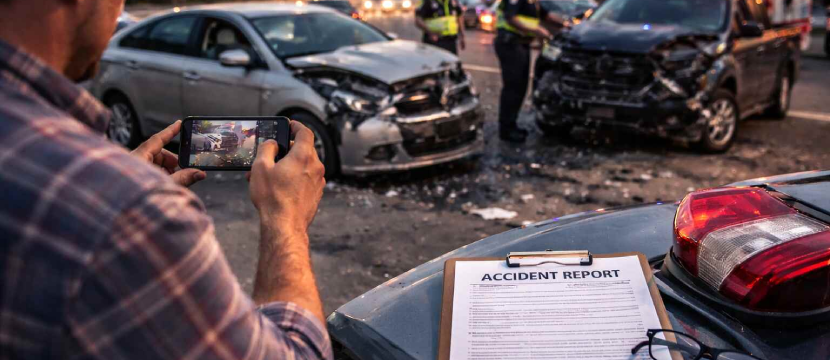
- Photograph Everything: Use your phone to take comprehensive photographs. Get wide-angle shots of the entire intersection, showing traffic signs, signals, and the final resting positions of all vehicles. Then, take close-up shots of all damage to your vehicle, the other vehicles involved, and any relevant road debris or skid marks.
- Identify Witnesses: Do not solely rely on the police officer’s investigation to gather witness information. Proactively approach people who saw the crash and get their full names, phone numbers, and email addresses. Their unbiased testimony can be invaluable later.
- Keep Your Narrative Short: When speaking to the other driver or even the police officer, identify yourself, provide your insurance and registration documentation, but avoid offering explanations, apologizing, or accepting blame. Simply state the facts (“My car was hit.”) and avoid making “incriminating statements” like “I didn’t see you” or trying to explain away the crash.
Working with Accident Reconstructionists
In complex cases where liability is disputed, such as a multi-car pileup on I-20 or a crash involving a commercial truck, we may utilize accident reconstructionists. These professionals use the evidence you preserved, the photos, the Black Box data, and the vehicle measurements to create a scientific model of the crash. They can determine the exact speed of impact and whether a driver attempted to brake. This level of detail is often what turns a “he said, she said” argument into a successful recovery for the victim.
Protecting Your Future Through Rigorous Evidence Preservation
A police encounter or a car crash does not have to result in a worst-case scenario. At Ray & Perry, we treat every car accident investigation with the intensity of a trial, ensuring that no stone is left unturned. We understand the nuances of the Mississippi legal system, from the Pine Belt to the Delta. Our goal is to provide the knowledgeable guidance necessary to protect your rights and your future. Whether you are dealing with a standard insurance claim or a complex litigation matter involving the Mississippi Tort Claims Act, we are prepared to stand by your side. Contact us to schedule a confidential consultation.
Frequently Asked Questions
What happens if the other driver’s insurance company calls me for a statement?
You should decline to provide a recorded statement until you have consulted with an attorney. Insurance adjusters may try to use your words to shift blame or minimize your injuries.
Can I still file a claim if the physical evidence at the scene is gone?
Yes, you can still pursue a claim using medical records, witness testimony, and expert analysis. However, it becomes more complex, making legal guidance important.
Is the Black Box data always available after a car crash?
Not always. The data can be overwritten or the device damaged. An attorney can send a spoliation letter to help preserve this evidence.
Should I take photos of my injuries after the accident?
Yes. Photographing your injuries over time helps document their severity and provides strong visual evidence for your claim.
What if the police report says the accident was my fault?
A police report is important but not final. Additional investigation may uncover new evidence that changes liability.
Do I need to keep my vehicle in its damaged state?
Yes. Avoid repairing or disposing of the vehicle until it has been inspected, as damage patterns are critical evidence.
What should I do with my medical bills and receipts?
Keep all documents related to your accident, including medical bills and lost wage records. These support your compensation claim.
How does the discovery phase work in a Mississippi car accident case?
Discovery is when both sides exchange evidence such as documents, witness lists, and expert reports. Strong documentation improves your case during this phase.